KTeaShop
Orchid Celadon Solo Tea Set – Korean Traditional Teaware
Impossibile caricare la disponibilità di ritiro
Details
Details
WHAT'S INCLUDED
- 2 celadon cups
- 1 strainer cup
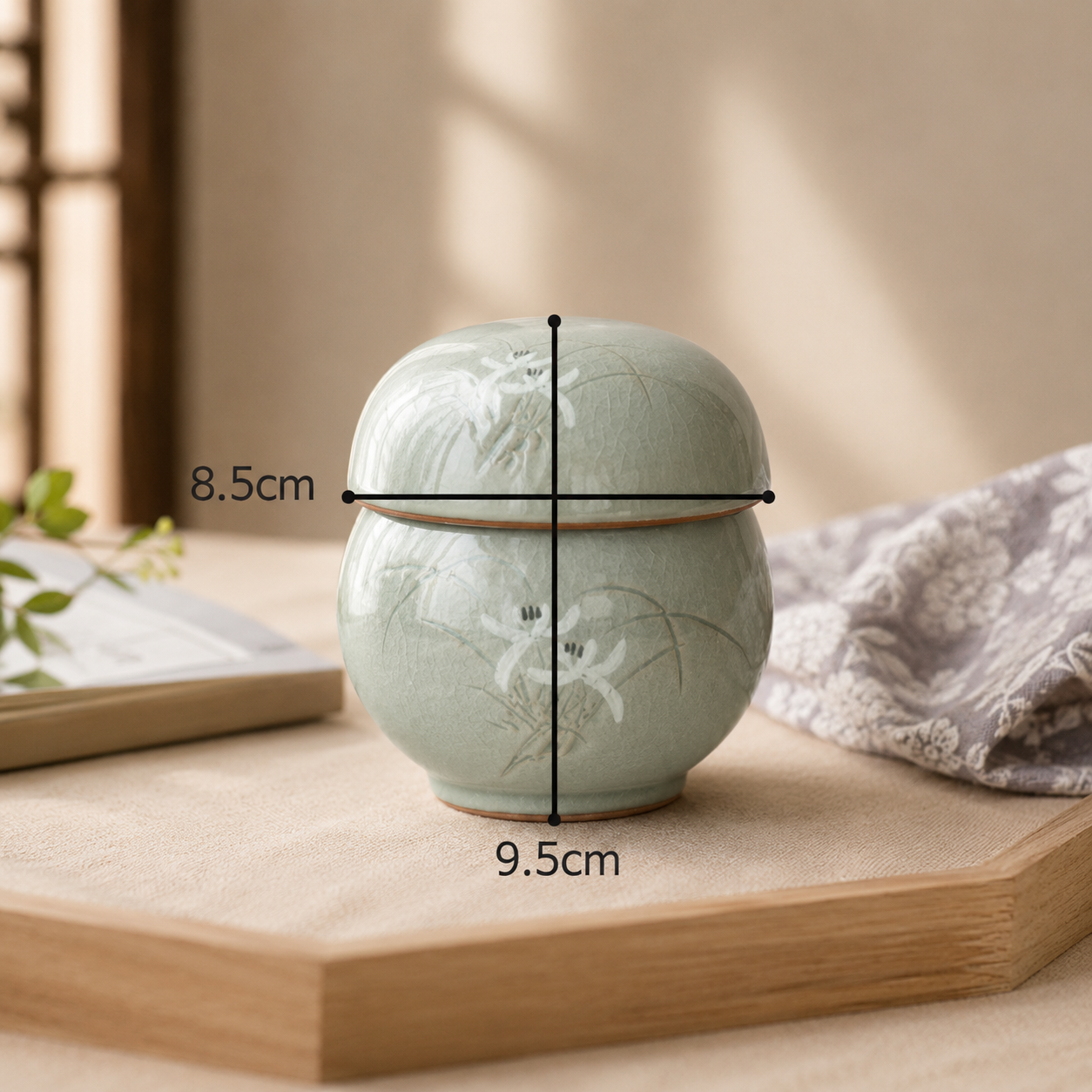
Detailed Size Information
SPECIFICATIONS
Material: Celadon ceramic (청자) Glaze Jade-green celadon glaze with orchid (난초) carved motif
Cup capacity : Approx. 70–80 ml per cup
Cup diameter Approx. 7 cm
Cup height: Approx. 4.5 cm
Finish :Handcrafted — slight variations in size, shape, and glaze tone are natural
Care: Hand wash recommended
Origin: Handmade in Korea
Who Is This For?
Who Is This For?
A cultural gift for someone discovering Korea.
For a friend who loved a trip to Seoul, a colleague curious about
Korean culture, or a guest you want to introduce to something real
— not a souvenir, but an artifact of everyday Korean refinement.
✦ Crafted by Doseong — Korean Celadon Master, carrying a tradition over 1,000 years old.
Stop giving gifts that get forgotten by next week.
Most teaware is mass-produced, arrives in a plain box, and means nothing a month later. The Doseong Orchid Celadon set is hand-thrown and hand-glazed by a Korean celadon master — and it looks like it belongs in a design museum, not a discount store.
One set. Two cups. A ritual that stays.
WHO IS DOSEONG?
도성 (Doseong) is a Korean ceramic master working in the tradition of cheongja (청자) — the jade-green celadon glaze that defined Korean court culture for over a millennium. Every piece is shaped and fired by hand, using techniques passed down through generations of Korean potters. No two sets leave the kiln identical.
THE PERFECT GIFT FOR
- A client or business partner — a gift that communicates taste, care, and cultural depth without a word
- A housewarming — a ritual object for a new space, two cups already waiting for the right guest
- The friend who always hosts — they set the table with intention. This belongs in their home
- Someone discovering Korea — not a souvenir, but an artifact of everyday Korean refinement
- Yourself — because a solo tea ritual is one of the few moments in the day that belongs entirely to you
FREQUENTLY ASKED QUESTIONS
Is this dishwasher safe?
Hand wash only. Dishwasher detergents and rapid temperature changes can dull the celadon glaze over time. A quick warm rinse after use is all it needs.
Is the glaze food safe?
Yes. The celadon glaze is food safe. If you ever notice chips or cracks, discontinue use and contact us.
Can I pour boiling water directly into the cups?
We recommend 80–95°C water. Korean teas like green and oolong brew best at this temperature — and it protects the cups from thermal shock over time.
Why do my two cups look slightly different?
Each set is handcrafted. Slight differences in glaze tone, texture, or shape are a natural result of the kiln process — it is what makes each set one of a kind.
How do I care for the cups long-term?
Rinse with warm water after each use. Avoid abrasive sponges. Store in a dry place. Over time the glaze develops a gentle patina — the cups become more beautiful, not less.
Share

Blog posts
Visualizza tutto-
"Ceremonial grade" doesn't mean what you think ...
"Ceremonial grade" doesn't meanwhat you think it does. I was sitting with a supplier and a farmer in Japan. In front of us were nine different Matcha from across...
"Ceremonial grade" doesn't mean what you think ...
"Ceremonial grade" doesn't meanwhat you think it does. I was sitting with a supplier and a farmer in Japan. In front of us were nine different Matcha from across...
-
How to Tell If Your Tea is Good Quality | Tea G...
How to Tell If Your Tea Is Actually Good Quality (And Why Most People Can't) You're standing in a tea shop in Zurich. Two green teas. One costs CHF 15....
How to Tell If Your Tea is Good Quality | Tea G...
How to Tell If Your Tea Is Actually Good Quality (And Why Most People Can't) You're standing in a tea shop in Zurich. Two green teas. One costs CHF 15....
-
Understanding Matcha Cultivars: Yabukita, Okumi...
Matcha cultivars such as Yabukita, Okumidori, and Samidori define the flavor, aroma, and texture of authentic Japanese matcha. Each cultivar—essentially a tea plant variety—has unique genetic characteristics shaped by region,...
Understanding Matcha Cultivars: Yabukita, Okumi...
Matcha cultivars such as Yabukita, Okumidori, and Samidori define the flavor, aroma, and texture of authentic Japanese matcha. Each cultivar—essentially a tea plant variety—has unique genetic characteristics shaped by region,...