KTeaShop
Buncheong Iron Orchid 3-Person Tea Set | Korean Traditional Teaware
Impossibile caricare la disponibilità di ritiro
Details
Details
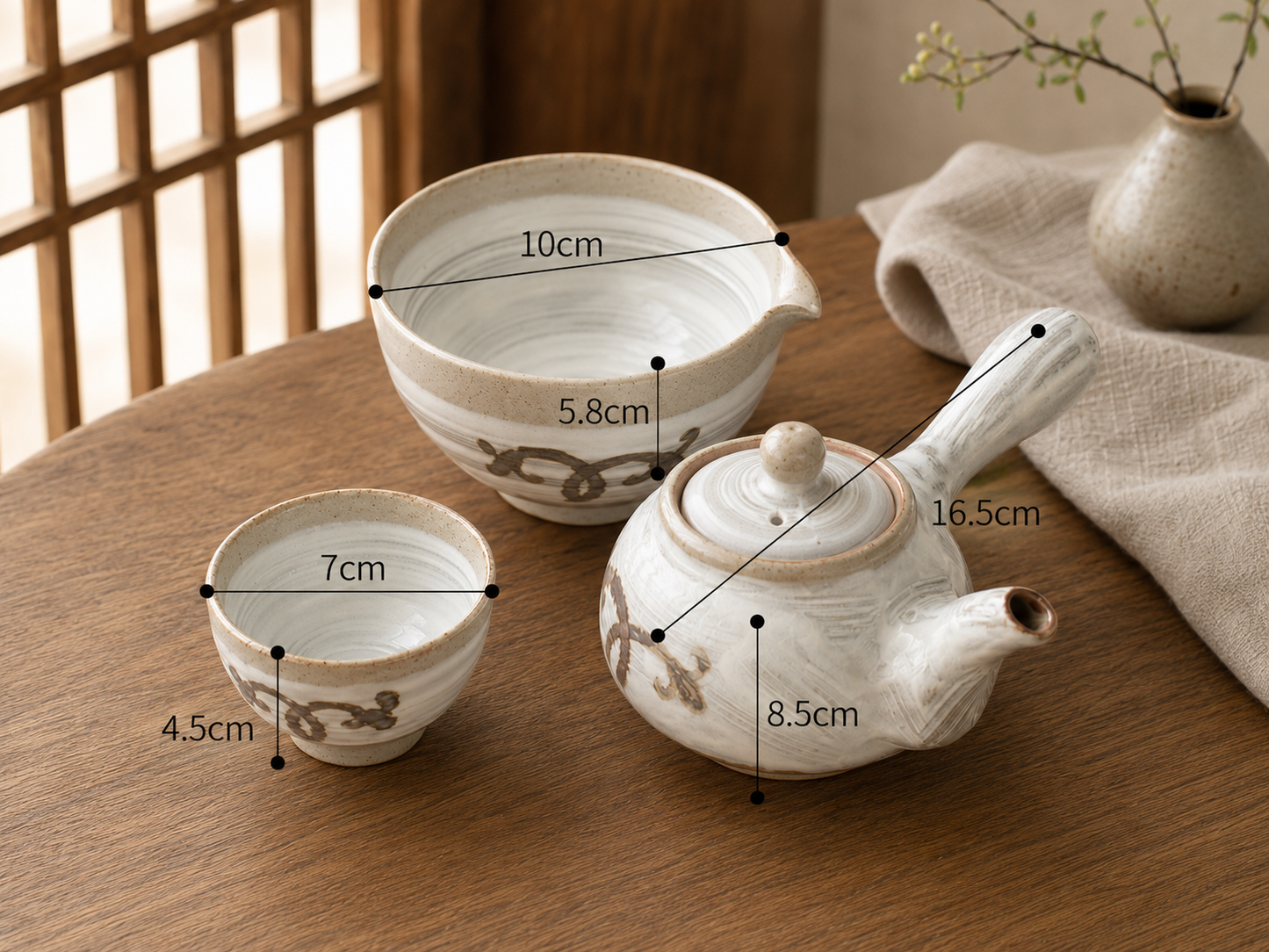
EXACT DIMENSIONS
Teapot16.5 cm (width incl. handle) × 8.5 cm (height)
Strainer cup10 cm (diameter) × 5.8 cm (height)
Tea cup7 cm (diameter) × 4.5 cm (height)
Total weight0.71 kg
Detailed Size Information
EXACT DIMENSIONS
Teapot16.5 cm (width incl. handle) × 8.5 cm (height)
Strainer cup10 cm (diameter) × 5.8 cm (height)
Tea cup7 cm (diameter) × 4.5 cm (height)
Total weight0.71 kg
Who Is This For?
Who Is This For?
THE PERFECT GIFT FOR
- The host who makes people feel at home — this belongs on their tea table, used every time guests arrive
- A senior colleague or business partner — refined, cultural, impossible to forget
- A wedding or anniversary gift — three cups for a new life shared with intention
- A corporate gift for someone who appreciates Korean craft — not a souvenir, an artifact
- Someone who has everything — except something made by hand, for the art of slowing down
For the gathering that deserves to be remembered.
Most host gifts are forgotten the next day. A Buncheong tea set for three creates a ritual — the kind guests remember months later. Not because of what it cost. Because of what it said about how they were received.
WHY THIS SET IS SPECIAL
Buncheong (분청사기) is not just pottery. It is a philosophy made visible.
Born in the early Joseon Dynasty (14th century), Buncheong ware rejected the rigid symmetry of Chinese porcelain in favour of something more honest — earthy, imperfect, deeply human. Korean potters developed a style rooted in 비움과 여백의 미: the beauty of emptiness and negative space. What is left out matters as much as what is put in.
The 난철사 (iron wire orchid) technique adds one more layer of meaning. Iron pigment is drawn freehand across the surface in a single flowing motion — like a brushstroke that cannot be corrected. The orchid (난) has represented quiet dignity, resilience, and refined character in Korean culture for over a thousand years. It does not shout. It is simply present.
Every piece from Bakssi Sangbang is hand-thrown and hand-painted. No mould. No machine. No two sets leave the kiln identical. This is not a mass-produced tea set that happens to look traditional. It is a living continuation of a craft tradition that has survived 600 years.
FREQUENTLY ASKED QUESTIONS
Is this dishwasher safe?
Hand wash only. Dishwasher detergents and rapid temperature changes can dull the iron brushwork and buncheong surface over time. A warm rinse after each use is all it needs.
Is the glaze food safe?
Yes. All glazes are food safe. If you notice chips or cracks over time, contact us.
Can I pour boiling water directly into the teapot and cups?
We recommend 80–95°C water. This protects the pieces from thermal shock and is the ideal brewing temperature for most Korean teas.
Why does each piece look slightly different from the photos?
Because it is handmade. Natural differences in color, pattern, and size are expected — and intentional. Each set from the kiln is singular.
How do I care for this set long-term?
Rinse with warm water after each use. Avoid abrasive sponges. Store in a dry place. Buncheong develops a gentle patina with use — the set becomes more personal over time, not less beautiful.
BEFORE YOU HESITATE
- Worried about fragile items in shipping? Every set is double-packed for ceramics. Arrives safely — or we replace it.
- Not sure it is right? 30-day returns, no questions asked.
- Ordering as a gift? Add a gift note at checkout — we will include it.
- Concerned about variations from the photo? Each piece differs slightly in color and pattern. This is the nature of handmade Buncheong — not a defect.
Share

Blog posts
Visualizza tutto-
"Ceremonial grade" doesn't mean what you think ...
"Ceremonial grade" doesn't meanwhat you think it does. I was sitting with a supplier and a farmer in Japan. In front of us were nine different Matcha from across...
"Ceremonial grade" doesn't mean what you think ...
"Ceremonial grade" doesn't meanwhat you think it does. I was sitting with a supplier and a farmer in Japan. In front of us were nine different Matcha from across...
-
How to Tell If Your Tea is Good Quality | Tea G...
How to Tell If Your Tea Is Actually Good Quality (And Why Most People Can't) You're standing in a tea shop in Zurich. Two green teas. One costs CHF 15....
How to Tell If Your Tea is Good Quality | Tea G...
How to Tell If Your Tea Is Actually Good Quality (And Why Most People Can't) You're standing in a tea shop in Zurich. Two green teas. One costs CHF 15....
-
Understanding Matcha Cultivars: Yabukita, Okumi...
Matcha cultivars such as Yabukita, Okumidori, and Samidori define the flavor, aroma, and texture of authentic Japanese matcha. Each cultivar—essentially a tea plant variety—has unique genetic characteristics shaped by region,...
Understanding Matcha Cultivars: Yabukita, Okumi...
Matcha cultivars such as Yabukita, Okumidori, and Samidori define the flavor, aroma, and texture of authentic Japanese matcha. Each cultivar—essentially a tea plant variety—has unique genetic characteristics shaped by region,...